


The Future of Bioremediation: Training Microorganisms to Tackle Environmental Pollution

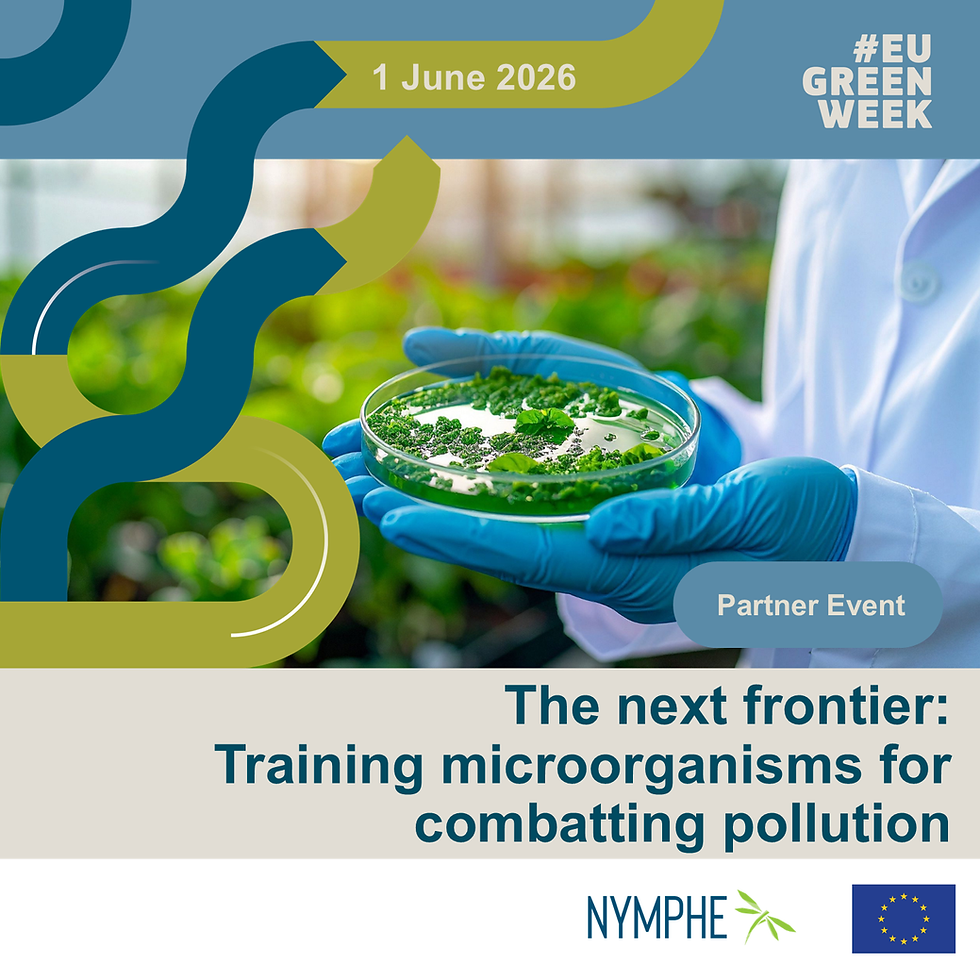
How can biological processes help tackle environmental pollution while supporting the goals of the EU Zero Pollution Action Plan and accelerating the shift toward a circular economy? These topics were discussed during the webinar “The Next Frontier: Training Microorganisms for Combatting Pollution”, where experts from the NYMPHE project shared their latest work on biological approaches to pollution remediation. The discussion explored how microorganisms, plants, fungi, and algae can remove, transform, or neutralise pollutants in soil, water, and industrial waste streams – all while enabling more sustainable resource use.
Bioremediation – at the core of Europe’s Green Transition
The conversation underscored the rising importance of bioremediation within both the circular economy and the broader bioeconomy. By regenerating contaminated resources, reducing pollutant loads, and minimising dependence on energy‑intensive or chemically intensive remediation methods, biological solutions offer a powerful pathway to restoring environmental quality. At the same time, they create new value by harnessing the natural capabilities of living systems.
Nature‑Based Technologies Shaping a Zero‑Pollution Europe
Talk 1 – How to turn environmental bacteria into super-cleaners: the issues and the tools
Talk 1 presented a comprehensive overview of how environmental bacteria can be harnessed as scalable tools for pollution remediation. It highlighted the severity and diversity of chemical pollution – ranging from legacy contaminants (e.g. PCBs), through emerging pollutants (pharmaceuticals), to highly persistent “forever chemicals” such as PFAS – and argued that microbial systems offer a uniquely powerful solution due to their metabolic diversity, adaptability, and evolutionary potential. The talk reviewed state-of-the-art approaches for identifying biodegradative organisms and pathways, including enrichment cultures, metagenomics, stable isotope probing, and computational mining, and showed how these discoveries can be enhanced through adaptive laboratory evolution and synthetic biology to generate strains with improved degradation, sensing, and response functions.
Beyond strain engineering, the presentation stressed the importance of the entire implementation pipeline: selecting robust and safe microbial chassis, designing genetic systems that function in environmental conditions, and addressing the often-overlooked challenge of field deployment through “environmental galenics” (formulation, encapsulation, and delivery strategies). It also showcased emerging concepts such as trans-kingdom remediation, where bacterial degradation pathways are transferred into plants to expand environmental reach. Finally, the talk addressed governance and biosafety, arguing for a shift from strict containment paradigms towards stewardship-based models emphasizing traceability, genomic barcoding, monitoring, and adaptive environmental management – positioning environmental biotechnology as a field that should evolve in a staged, medicine-like framework from laboratory research to monitored real-world application.
In essence, the seminar delivered a central message: microorganisms are uniquely equipped to combat pollution, but unlocking their full potential requires not only improved strains, but also improved methods for discovery, engineering, deployment, monitoring, and governance.
WASTEWATER TREATMENT - Nymphe technologies
Talk 2 – Electroactive Microbes for Cleaner Wastewater
METland® Microbial Electrochemical Technologies (METs) for Enhanced and Sustainable Bioremediation of Wastewater Pollutants.
In the second presentation, Abraham Esteve-Núñez introduced METland® – an innovative wastewater treatment technology based on Microbial Electrochemical Technologies (METs). The presentation provided an overview of microbial electrochemistry, an emerging scientific field that explores how microorganisms interact with conductive materials and exchange electrons with electrodes. This unique capability can be harnessed to enhance biological treatment processes and improve the removal of contaminants from wastewater.
The speaker demonstrated how integrating conductive materials into constructed wetlands can significantly enhance the biodegradation efficiency of microbial communities. Through several case studies, he presented the application of METland® for the treatment of urban and industrial wastewater, including the removal of pharmaceutical residues and other emerging pollutants that are often difficult to eliminate using conventional treatment methods.
The presentation highlighted the potential of METland® as a sustainable, nature-based solution that combines the advantages of wetland systems with advanced microbial processes. By improving treatment performance while reducing infrastructure requirements and environmental impact, the technology offers a promising approach to addressing growing concerns related to water pollution and resource-efficient wastewater management.
Key Topics and Findings:
Microbial Electrochemistry (METs): The core technology is based on microbial electrochemistry, which studies the interaction between microorganisms and electrodes, enabling certain bacteria to transfer electrons to electro-conductive materials.
Electro-active Wetlands (METland®) Design: The technology builds on a novel wetland design in which conventional inert materials are replaced with electro-conductive materials, creating conditions that stimulate enhanced microbial activity and pollutant degradation.
Enhanced biodegradation: The electro-conductive network enables bacteria to interact over greater distances, expanding their metabolic activity. This can result in up to a tenfold increase in biodegradation rates or, alternatively, a tenfold reduction in the treatment footprint required.
Proof of mineralisation: The technology has demonstrated true biodegradation and mineralisation of pollutants, including antibiotics and pharmaceuticals. Using 14C tracing, researchers confirmed that contaminants are fully degraded rather than simply absorbed or retained within the system.
Enantiomer-specific metabolism: Studies have shown that electro-active microorganisms can differentiate between and metabolise specific enantiomers, providing additional evidence of active biological degradation processes.
Diverse wastewater applications: The technology has been successfully applied to both highly concentrated industrial pharmaceutical wastewater and urban wastewater containing low concentrations of micropollutants, demonstrating its versatility across different treatment scenarios.
Toxicity reduction: In addition to removing contaminants, the treatment process has been shown to significantly reduce water toxicity, addressing a critical requirement for water reuse.
Scalability and decentralisation: Modular and scalable METland® systems have been developed, including vertical garden configurations capable of treating substantial volumes of water (approximately 0.1 m² per person), making them well suited for decentralised urban applications.
Future optimisation through accelerated evolution: Future developments will focus on accelerating the evolution and adaptation of microbial communities to overcome current limitations, such as oxygen constraints and very low pollutant concentrations, with the aim of further enhancing biodegradation performance.
Read more about this technology: https://www.nympheproject.eu/_files/ugd/5ab4e5_2a218dd1bc754337993625344cbc4348.pdf
Talk 3 – Training microbes for wastewater treatment: Electro-oxidation + biodegradation of microplastics
The presentation addressed one of the most pressing environmental challenges associated with wastewater treatment: the persistence and accumulation of microplastics. While wastewater treatment plants capture the majority of microplastics, a portion remains in treated water and is released into the environment, while the rest accumulates in sewage sludge and eventually reaches agricultural soils. The speaker highlighted that common petroleum-based plastics, such as polyethylene, PET, PVC, and polyamides, are particularly difficult to degrade because they were designed to be durable and resistant to natural breakdown processes.
Combining Electrochemical Conditioning with Microbial Degradation for Enhanced Plastic Breakdown
To overcome this challenge, the presentation introduced an innovative two-step remediation strategy that combines electrochemical conditioning with microbial degradation. The approach uses an electro-Fenton process to modify and partially oxidise the surface of microplastics, creating favourable conditions for microbial attack. In the second stage, specialised microbial consortia, selected and adapted to utilise plastics as a carbon source, further degrade the conditioned materials. The results demonstrated that combining both processes significantly improves plastic degradation compared to either approach alone, highlighting the potential of integrated abiotic-biotic systems for addressing microplastic pollution.
Key Takeaways
✅ Microplastic pollution remains a major challenge for wastewater treatment systems, with a fraction of particles ultimately reaching water bodies and soils.
✅Conventional microbial degradation of plastics is limited because the highly resistant structure of plastics restricts microbial access.
✅ Electrochemical conditioning can significantly improve biodegradation by fragmenting plastics, increasing surface area, and creating reactive sites for microbial colonisation.
✅ Specialised microbial consortia adapted to plastic-rich environments possess the genetic potential to degrade a range of synthetic polymers, including polyethylene.
✅The combination of electro-Fenton treatment and biological degradation achieved substantially higher removal efficiencies than either process alone, demonstrating the value of integrated remediation strategies.
✅Further optimisation is needed to increase degradation rates, improve the integration between electrochemical and biological treatment stages, and support future regulatory requirements for microplastic removal.
✅ The approach represents a promising and scalable pathway towards more effective and sustainable management of plastic pollution in wastewater systems.
Read more about this technology: https://www.nympheproject.eu/_files/ugd/5ab4e5_cb9cd478618e43a7bc74926669d545bb.pdf
Talk 4 – Bioremediation of Agricultural Soils Contaminated with (Micro)plastics Using Ecopiles
Two Converging Threats in Agricultural Soil
The presentation addressed the growing challenge of agricultural soil contamination caused by the combined accumulation of plastic residues and pesticide compounds. While these contaminants are often studied separately, they frequently coexist in agricultural environments, where they interact and contribute to soil degradation, biodiversity loss, groundwater contamination, and reduced climate resilience. Given that more than 60% of European soils are already degraded, innovative and scalable remediation solutions are urgently needed.
Problem scale
>60% of European soils are degraded
4M+ tonnes plastic mulch used per year in EU
400K+ contaminated sites across Europe
€17B annual economic cost of soil degradation
What are Ecopiles?
To address this challenge, CHQ is developing Ecopiles, a nature-based bioremediation technology specifically designed for agricultural soils contaminated with both plastic residues and pesticides.
The solution builds on the concept of traditional biopiles, but incorporates a carefully selected consortium of bacteria and fungi with complementary degradation capabilities. Together, these microorganisms facilitate the breakdown of plastic residues, pesticide compounds, and their degradation products, while preserving soil health and supporting ecosystem functionality.
Each member was selected for functional complementarity, biosafety compliance, and field robustness. Together they address the full contaminant matrix - no potential pathogens detected at any timepoint.
Ø Complex Community - Bioclean-up of weathered conventional plastics and bioplastics degradation (PL)
Ø Fungal Partner - Enzymatic breakdown (F)
Ø Bacterial Isolate - Spinetoram degradation (M1)
Ø Bacterial Isolate - Pesticides degradation (M3)
Laboratory studies and a 12-month field trial in Greece demonstrated the effectiveness of the approach. The results showed significant reductions in pesticide concentrations and plastic contamination, while no negative impacts on soil quality, microbial activity, plant growth, or crop productivity were observed. The findings highlight the potential of Ecopiles as a sustainable, cost-effective, and scalable solution for restoring contaminated agricultural land across Europe.
Key Takeaways:
✅ Agricultural soils are increasingly affected by the combined presence of plastic residues and pesticide contamination, creating complex environmental challenges that require integrated remediation approaches.
✅ Ecopiles represent an advanced evolution of traditional bioremediation systems, specifically designed to address contamination in agricultural environments.
✅ The technology relies on a multifunctional microbial consortium combining bacteria and fungi selected for plastic degradation, pesticide removal, biosafety, and field robustness.
✅ Laboratory validation identified a four-member microbial consortium that consistently outperformed partial biological treatments in contaminant removal and biofilm formation.
✅ Field-scale trials demonstrated substantial remediation potential, achieving up to 70% reduction of plastic fragments and up to 90% removal of selected pesticides.
✅ The technology successfully promoted the degradation of biodegradable mulch films and enhanced the biological cleaning of weathered polyethylene residues.
✅ No adverse effects on soil health, microbial activity, plant development, or crop yield were detected, confirming the environmental safety of the approach.
✅ Ecopiles offer a promising nature-based solution that can support soil restoration, sustainable agriculture, and the broader objectives of the circular economy and EU soil protection policies.
“The Next Frontier: Training Microorganisms to Combat Pollution” – summary
The webinar explored how advances in microbiology, synthetic biology, and environmental biotechnology are reshaping approaches to pollution remediation. Experts from the NYMPHE project demonstrated how microorganisms, plants, fungi, and algae can be harnessed to transform pollutants in soil, water, and industrial streams into less harmful or even valuable compounds, supporting both environmental restoration and resource circularity.
Across four thematic presentations, the webinar highlighted the growing convergence between bioremediation, circular economy principles, and next-generation biotechnology tools. From microbial engineering and electroactive systems to hybrid abiotic–biotic processes and large-scale field applications, the discussions showcased how biological systems can be systematically designed, enhanced, and deployed to address complex contamination challenges.
A strong cross-cutting message was that microbial solutions are no longer limited to laboratory-scale concepts. Instead, they are increasingly being developed as integrated systems that combine discovery, engineering, deployment strategies, and environmental governance frameworks, enabling more realistic pathways toward real-world application. Particular emphasis was placed on scalability, safety, traceability, and the need for adaptive regulatory and monitoring approaches.
The webinar ultimately underscored a paradigm shift: microorganisms are emerging not only as natural degraders of pollutants, but as engineered environmental tools capable of supporting systemic solutions to pollution at scale, provided that scientific innovation is matched with robust implementation and governance frameworks.
AGENDA:
10:00 – 10:10 Welcome and Nymphe project overview
Giulio Zanaroli, Nymphe Coordinator, University of Bologna, Italy
10:10 – 10:30 | Talk 1 – How to turn environmental bacteria into super-cleaners: the issues and the tools
Victor de Lorenzo, Systems Biology Department, Centro Nacional de Biotecnología (CSIC), Spain
10:30 – 10:50 | Talk 2 – Electroactive Microbes for Cleaner Wastewater
Abraham Esteve Nunez, METFILTER S.L., Spain
10:50 – 11:10 | Talk 3 – Training microbes for wastewater treatment: Electro-oxidation + biodegradation of microplastics
Luis Bañeras Vives, Professor (Assistant) at the University of Girona (UdG)
11:10 – 11:30 | Talk 4 – Bioremediation of Agricultural Soils Contaminated with (Micro)plastics Using Ecopiles
Evi Syranidou, Head of Biotechnology Group, CHQ Technologies P.C.
11:30 - 11:35 | Q&A


Comments